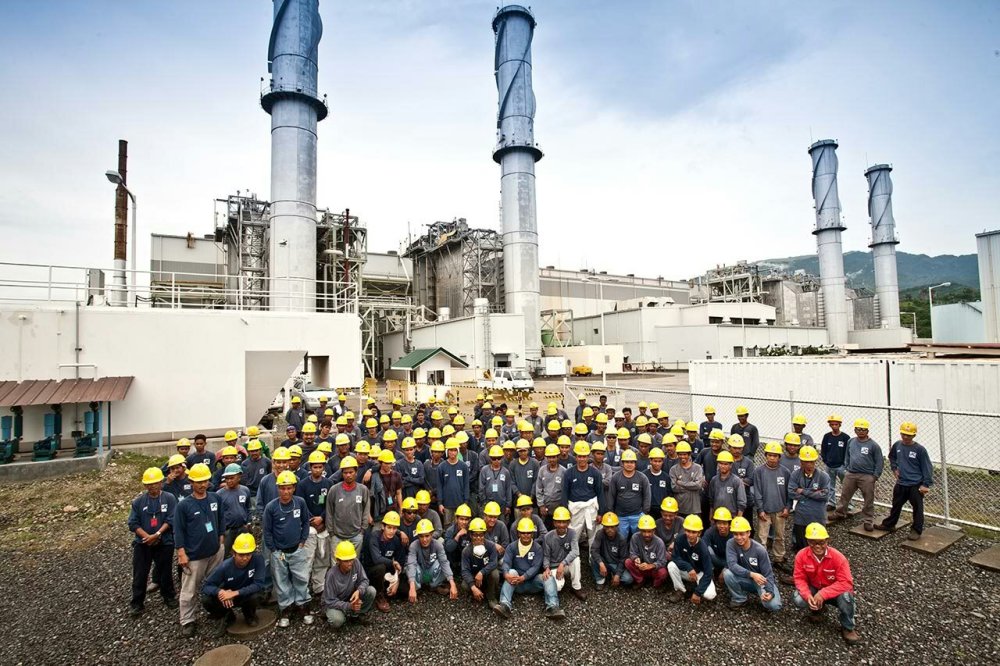
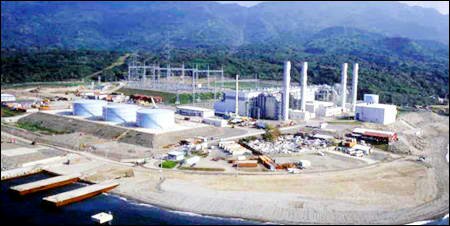
Ilijan Combined-Cycle Power Plant is a dual-fuel power station in Ilijan, Batangas City. It is primarily a natural gas plant and usesdistillate oil as a secondary back-up fuel source. With the nameplate capacity of 1200 MW, it is the largest natural gas facility in thePhilippines. The plant is designed to draw natural gas from the Malampaya gas field.
The plant is the first power facility in the country to use the 500 kV switchyard system and reverse osmosis system.The Ilijan plant’s construction began in March 1999 and was commissioned in June 2000.
The Ilijan Power Plant sits on a 60-acre site at Arenas Point, Barangay Ilijan, Batangas City and was constructed and is owned by KEPCO (through its local subsidiary, KEPCO Ilijan Corporation) pursuant at a 20-year ECA with NPC under a BOT scheme that expires or June 4, 2022.

NPC supplies gas to the Ilijan power plant from the Malampaya field in Palawan. The Ilijan Power Plant consists of two blocks with a rated capacity of 600 MW each. The power plant can also run on diesel oil stored on site.
On April 16, 2010, SMC successfully bid for the appointment to be the IPPA for the Ilijan Power Plant and received a notice of award from PSALM on May 5, 2010. On June 10, 2010, SMC and SPPC (Ilijan) entered into an Assignment Agreement with Assumption of Obligation whereby SMC assigned, with the consent and conformity of PSALM, all of its rights and obligations under the Ilijan IPPA Agreement to SPPC administration of the Ilijan Power Plant.
History remembers the time when Filipino soldiers bravely fought side by side with Koreans in thier joint struggle for freedom and domocracy in the Korean War of the 1950s. Through the year, the cooperation between Korea and Philippines continues to advance and strengthen in the economic, political and cultural spheres.
These ties have prompted the Korea Electric Power Corporation(KEPCO), a globally competitive and leading electric utility provider which contrils the generation, transmission and distribution of electricity in Korea, to respond to the Philippine Goverment’s call to increase the country’s power supply, develop and utilize its indigenous resources.
KEPCO participated in, and subsequently won, the international biddings for the Rehabilitation, Operation, Maintenance and Management (ROMM) of the 650MW Malaya Thermal Power Plant in Pililla, Rizal in May 1995 (implemented by KEPCO Philippines Corporation or KEPHILCO); and the Build-Operate-Transfer (BOT) of the 1200 MW Ilijan Combined-Cycle Ilijan, Batangas Natural Gas Power Project in October 1996 (implemented by KEPCO Ilijan Corporation or KEILCO).
The rehabilitation phase of the 20 year old Malaya plant was completed in October 1998, 10 months ahead of schedule. The successful recovery of the plant’s original rated generation capacity of 650 MW is equivalent to the building of a new 220 MW power plant but at a much lower cost. In addition, the thermal efficiency was improved by an average of 4.5%. The Malaya plant curently provides stable and reliable electricity to the Luzon Grid.
The Ilijan Plant was principally designed to operate as a base-load unit using natural gas sourced from the Malampaya gas fields in Palawan with diesel as back-up fuel. The Project is in line with the Philippine Government’s thrust of utilizing its indigenous energy resources, particularly natural gas. Cited by POWER Magazine as one of the top 12 power plants of the world, the plant boasts of state-of-the-art, highly efficient 501G gas turbines (known of having one of the highest efficiency ratings among all industrial gas turbines in the world) that exhaust into a three-pressure reheat natural circulation heat recovery steam generators.
KEPCO Philippines continues to explore new projects and consequently address the impending power shortage in the Visayas region as it takes on the construction of a 200 MW Circulating Fluidized Bed Combustion (CFBC) Power Plant in Naga, Cebu. The plant shall utilize the CFBC boiler-type technology whose emission system is proven to be environmentally-sound by over 500 CFBC units currently operating safely worldwide. The Project is implemented by Kepco SPC Power Corporation, a joint venture of KEPHILCO and SPC Power Corporation under a Build-Operate-Own (BOO) scheme.
These outstanding milestones manifest the state-of-the-art technological excellence and competence of KEPCO. With its significant contribution of a stable and reliable power supply in the Philippines, KEPCO Philippines has emerged as a major player in the Philippine energy industry.
KEPCO’s Philippine operations, with the KEPHILCO and KEILCO power plants, currently provide approximately 16% of Luzon’s installed generation capacity or 12% of the Philippines’ installed generation capacity.

The Korea Electric Power Corp. (KEPCO) is a tycoon here ― not only is it the biggest South Korean state-run entity, but one of the country’s biggest companies in overall rankings. But instead of settling in the stable throne at home, it has chosen to advance into overseas markets.
In June, the utility company acquired a 17-percent stake in Denison Mines, a Canada-based uranium mining company, as well as an output agreement.
Under the newly-signed agreement, KEPCO will purchase 58 million common shares of the world’s 10th largest uranium miner, giving the company the right to appoint two directors to its board of directors.
With the deal, KEPCO has secured 20 percent of Denison’s annual uranium production from next year through 2015. The five-year amount, assessed to be 300 tons per year, accounts for some 8 percent of South Korea’s annual consumption.
KEPCO CEO Kim Ssang-soo said this year is the best time for making mergers and acquisitions before the global economy starts to fully rebound.
“By securing the deal, KEPCO resumed its place in the uranium industry that it had to sell off during the Asian financial crisis a decade ago. This is a meaningful achievement in that it is the first case of securing an overseas uranium source since then,” Kim said.
Also this year, the energy firm signed a $2.5-million deal to build and operate a coal-fired power plant in Kazakhstan. Teaming up with Samsung C&T, KEPCO finalized the agreement on the Balkhash Plant Project in March with Kazakhstan’s state holding firm Samruk.
The power station, aimed to be completed by 2014, will have generating capacity of between 1,200 and 1,500 megawatts.
As such, the company has successfully made inroads into the resource-rich Central Asia in collaboration with state-run and private companies, KEPCO said. A series of follow-up projects will be also available with the breakthrough in economic cooperation between Korea and Kazakhstan.
KEPCO says self-complacency will get the company nowhere in the fluctuating domestic energy market, as recent signs have strongly suggested.
Demand for electricity grew over 10 percent each year in the 1990s, but has been rapidly declining since the turn of the new century due to the slowing local economy and a change in the industrial structure into a less energy-consuming sector.
This year’s growth is forecast between 3 and 4 percent, and the figure is likely to fall to around 1 percent after next year, according to the Korea Energy Economics Institute.
In addition, policies for the domestic market look to facilitate the participation of private firms. In 2015, private operators are expected to account for 10 percent of the local market.
Aiming to get over its domestic limitations, KEPCO started to make overseas business forays in the 1990s, starting with other Asian countries.
It established a foothold in the Philippines, after winning consecutive bids for the 650-megawatt Malaya Thermal Power Plant project in 1995, and the 1,200-megawatt Ilijan combined-cycle plant project in 1996.
Now its Philippine unit is one of the country’s top 10 power companies, producing some 12 percent of nationally consumed power.
Following success in the Philippines, the company eyed China. Currently it is operating a wind-power generation plant and combined power generation and resources exploration businesses in Shanxi Province.
Endless Pioneering
While pursuing continuous growth in the Northeast Asian market, KEPCO is also aggressively trailblazing new markets including the Middle East and Africa.
In December 2005, the power utility bagged a government-ordered contract for the operation and management of an 870-megawatt combined-cycle thermal plant in Lebanon. KEPCO took over the plant the next year, before starting its commercial operation.
Its African move started with a Nigerian deal in 2006, which allowed KEPCO to build and operate a 2,250-megawatt gas power plant and manage a 1,200 kilometer-long gas pipeline.
In the same country, it also won offshore oil-drilling rights for an estimated reserve of 2 billion barrels of oil, an amount 2.5 times Korea’s annual domestic consumption.
Another area for KEPCO’s overseas business comes from the seemingly opposite end of power generation _ the clean development mechanism (CDM) businesses and exports of Korean-style nuclear reactors. In CDM projects, KEPCO make profits by acquisition of CO2 emission credits, which are given to companies that advance into new and renewable energy businesses, including wind power projects.
KEPCO is the largest foreign operator of the Chinese wind power market, with an overall capacity reaching 167.3 megawatts from its plants in Inner Mongolia and Gansu Province. The company expects an annual $6.2 million profit from its Chinese CDM projects.
On the nuclear side, attempts are ongoing to export some 300 reactors by 2030, in expectations that nuclear generation will regain popularity amid high oil prices and strengthening energy-related regulations.
With the understanding that exporting nuclear facilities largely lies on negotiations and diplomacy by the government, KEPCO plans to concentrate its marketing efforts on target countries such as the United Arab Emirates, Turkey, Jordan and China. Groundwork will also be maintained in potential markets like India.
Looking to become a global energy giant in the future, KEPCO is set to take its role of contributing to the development of the national economy by exporting electricity technology, with parallel moves in CDM and nuclear power.

 Ilijan Combined-Cycle Power Plant